


Table of Contents

Thermal In Front Of Scope
Technologies behind thermal scopes used to be prohibitively expensive. Thermal In Front Of Scope. They were only available to those with deep pockets and big budgets, such as the military and the larger law enforcement agencies. However, with the advances technological advancements, the cost for thermal scopes has dropped significantly and they are now more accessible than ever before.
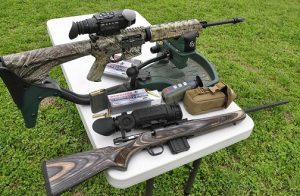
The growing availability of thermal scopes has resulted in an increase in demand for hunter-based activities that are nocturnal, such as hog and coyote. The result is that this increasing demand from consumers has prompted dozens of companies to enter the market and make thermal scopes available to a greater number of hunters and shooters as never before. Whether you’re looking to get your first one or upgrade to a more advanced model, we’ll help you discover some options for the best thermal scopes so that you, too, can get in on the action.
The Best Thermal Scopes For 2022
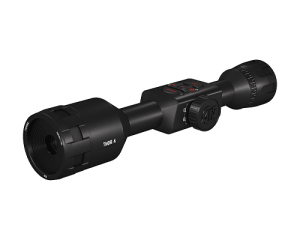
- Best Value for Money: OPMOD Thor LT 3-6x
- Best Over $5000: Trijicon IR Hunter MK3
- Best Thermal Scope under $500: AGM Secutor TS25-384
- The Best Thermal Scope for Under $1000 ATN Thor HD 384 2-8x
- Best Thermal Scope for Budget: ATN Thor 4 384 1.25-5x
- Ideal for hunting: ATN Thor LT 160 3x
- Best Hot Scope for Hog Hunting: Sig Sauer Echo 3
- Best Clip-On Thermal Scope: Burris BTC 50
- The best surveillance tool: Trijicon IR-Patrol IRMO 300 Rifle Kit
Things to Consider Prior to Purchasing the Thermal Scope
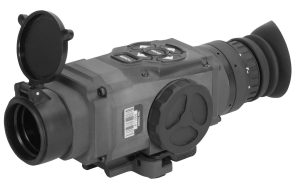
You’ve probably figured out it’s true that best thermal scopes aren’t cheap. A majority of people don’t spend a sizable chunk of change on an expensive thermal scope on a whim. There are some things that you should be thinking about before deciding what thermal scope is the best choice for you. (Or really whether you really need one, or if you could use the money elsewhere.)
If you look on the internet, you will find companies that offer thermal scope rentals. This is a great option to test various designs and get a feel of what you prefer best before making a purchase. Thermal In Front Of Scope.
Of course, the ultimate choice is yours However, if you think that your next gun-related purchase will be a thermal scope, then here are some of the things you should consider prior to spending your hard-earned cash:
Battery Life
There’s a lot of tech packed into the thermal scope, and it’s required to be powered by some kind of battery to run it. Not all batteries are created equal, and so you want to be sure you have a battery that will ensure your thermal scope will stay running for as long as you need it. This means you’ll want to consider how long you plan to be using the scope during a single period, how long does it take to chargeit, and what will spare batteries cost.
Extra Features
Certain thermal scopes include WiFi, GPS, Bluetooth and more. They’re all fantastic features to have however you need to think about what you’ll use this thermal scope to do and whether these extra features are worth it or not. Consider, for instance is it really necessary to be able streaming your scope picture to your mobile device?
Price And Budget
The best thermals are going to exceed $5000. Although these are typically the top-of-the-line scopes you can buy but you’ll also get useful usage from models in the $2000-$5000 price range. If you’re looking for a cheap thermal scope under $1000, it’s unlikely to find one. There will be some thermal units under $2000 but they should be brand-specific to ensure a good assurance of warranty and money-back guarantee since quality control issues are to be to be expected in this price range.
Size And Weight
Thermal imaging scopes have been huge and heavy. Average weight for a standard thermal rifle scope is 2 pounds. The light thermals weigh between 1-1.5 pounds, which is similar to regular daylight rifle scopes. While thermals might be the same length of conventional rifle scopes, and even shorter, the internal components needed to provide thermal imaging makes them wider. Their overall weight and size will affect the hunting or tactical weapon as well as sight system.
A lightweight and compact option may be to consider a clip-on system. In addition to reducing size and weight, they’re specifically designed to be placed in front of your daytime scope and should be easily removed and attached.
Operation Range
Thermals can provide more than 1000 yards of range of detection on targets, regardless of day as well as night conditions. However the distance that you are able to recognize and pinpoint what you are looking for will be considerably shorter.
The ranges of these will differ between manufacturers models, models, as well as quality. The thermal detector’s sensitivity will be the primary factor you want to research. Increasing magnification can help to quickly identify and locate a faraway target, but it can also cause poor pixelation, resulting in a blurred image. Display resolution will also determine what the image quality is. sight picture. Thermal In Front Of Scope.
Which Is Better Thermal Or Night Vision?

Instead of focusing on the fact that the night vision scope will be better than thermal or in the reverse direction, the main problem is:
Which one is the best to meet your needs and budget?
By the end of this guide, you’ll know precisely what the solution is.
Let’s get started!
Night Vision
Night vision works by using light as reflections or light and transforming the light into the crystal clear image.
Thus, it requires some sort of ambient light for its operation.
If you shoot at night, the moonlight and stars usually provide enough light. Modern models have infrared illuminations that function as flashlights for the scope but aren’t visible the naked eye.
If you’re browsing markets of night vision optics, you’ll see different classifications for them.- Gen I, II or III. In simple terms, the higher the level of the generation, the higher the quality.
There’s also a newer classification of night vision scopes known as Digital Night Vision.
The normal night vision displays the traditional black and green as the new digital night vision is typically shown in black and white across the screen of the LCD.
Pros
- Night vision offers a superior image.
- It allows you to differentiate between the finer detail. In addition, night vision scopes are more affordable and more compact in dimensions. They are not affected by cold weather.
The night vision technology is in use more as thermal optics. Night vision scopes can be found being mounted on rifles and are generally more rugged, stable, and absorbs recoil like a pro.
Cons
- The need for ambient light makes night vision limited.
So unless you have an infrared illuminator, it’s pretty much useless in darkness. It’s not suitable for use in bright sunlight, as it can is permanently damaged when exposed to bright light.
Thermal Imaging
Thermal scopes detect radiation or heat given off from any living thing. Thermal imaging employs a specific kind of lens that focuses upon infrared light and generates the thermogram. This thermogram is then turned into electrical signals that form a picture on your screen. Thermal In Front Of Scope.
Pros
- Thermal vision is more versatile since it can be used in any light situation. One of the most significant advantages of thermal imaging scopes is that they function correctly in the day and night and do not need infrared light. In addition you’ll be able discern smoke, dust, and fog with ease. That’s why firefighters employ thermal technology.
Cons
- One of the main drawbacks for thermal imaging is that it’s very heavy to carry. They can also be expensive, and may require you undergo training in order to understand the images properly. The battery’s life span is typically short and the quality of the images can be negatively affected by lower temperatures.
Frequently Asked Questions
How long does an Thermal Scope last?
In the an average thermal scopes run for about eight hours on a single charge. Various models will vary between 2-10 hours. Recently, ATN has managed to create ultra-low consumption thermal scopes that can provide 10+ hours of continuous usage.
Why is it that Thermal Scopes are so expensive?
The majority of the time, thermal scopes can be expensive because of advanced technological components. There are also price differences with various features such as Bluetooth connectivity and palette modifications as well as ballistics applications and more. However, thermals start at a reasonable price point of $1000.
How far can Thermal Rifle Scopes View?
The distance thermal rifle scopes can see depends on factors such as resolution of the display as well as magnification levels. The majority of basic thermals will detect heat signals at 1,000or more yards. Top-quality thermals can detect up to the 4,000-yard mark, but it is not easy to identify targets.
Can You Use Thermal Scope for Daylight?
In contrast to night vision scopes however, you can utilize thermal scopes instead. You can use a thermal scope throughout the day without damaging components. Instead of intensifying light, thermal scopes read heat signatures. The dual-use functionality is a major benefit of choosing thermal instead of night vision and making the most out of your investment. Thermal In Front Of Scope.
